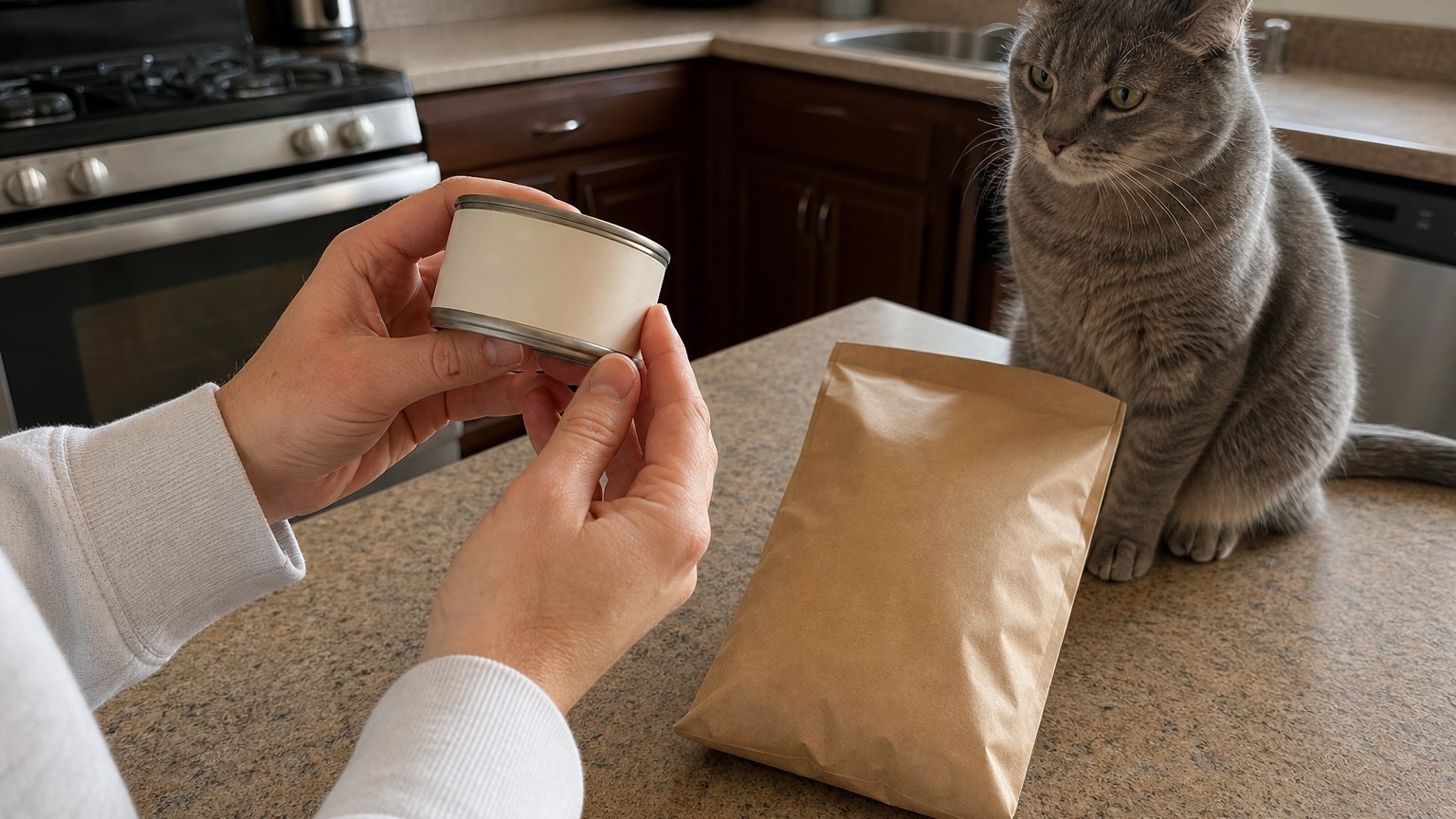
Two cans sit on the shelf. Both say “chicken” in big letters, but one says “Chicken Dinner” and the other says “with Chicken.” Here’s how to read a cat food label: start with the nutritional adequacy statement (is it “complete and balanced” for your cat’s life stage?), then check the guaranteed analysis, the ingredient list and the calorie statement. The front of the package tells you much less than it seems to.
Below is the order I’d read it in, what each part means, and one made-up label walked through from top to bottom.
Read a cat food label in this order
- Adequacy statement. Look for “complete and balanced” and the life stage (adult maintenance, growth, or all life stages).
- Product name. Check which naming rule it follows, so you know how much of the named ingredient is in there.
- Guaranteed analysis. Compare foods on a dry matter basis, not the raw numbers.
- Ingredient list. Ingredients appear in order by weight.
- Calories and feeding directions. Use them to set a starting portion.
- Who made it. Find the company name and address in case you have questions.
Everything else on the package is marketing until you’ve checked those six.
Who sets the rules for cat food labels?
In the US, the FDA oversees pet food. FDA says it makes sure animal food is safe, properly manufactured and truthfully labeled.
AAFCO (the Association of American Feed Control Officials) is a different kind of group. It’s a voluntary association of feed control officials and has no regulatory authority itself. Its label models are not official regulations, but most states have adopted a version of them. That’s why you see the same wording on so many cans and bags.
1. The nutritional adequacy statement
This is the line that tells you whether the food can be your cat’s main diet. AAFCO calls it perhaps the most important part of a label.
“Complete” means the food has all the nutrients a cat needs. “Balanced” means they’re in the right ratios. FDA adds that “complete and balanced” means the food is intended as the sole diet, and treats typically aren’t.
A food can back that claim in two ways, and the wording differs:
- Feeding trial: “Animal feeding tests using AAFCO procedures substantiate that [product] provides complete and balanced nutrition for [life stage].”
- Formulation: “[Product] is formulated to meet the nutritional levels established by the AAFCO Cat Food Nutrient Profiles for [life stage].”
Both are acceptable ways to make the claim. Check that one of them is there.
Then check the life stage. The options are gestation/lactation, growth, maintenance, or all life stages. A kitten needs a growth or all-life-stages food, while an adult can eat maintenance. Not sure which stage your cat is in? Try the cat age calculator.
If you see “intended for intermittent or supplementary feeding only,” the food doesn’t meet the complete and balanced standard. It’s meant as an extra, not a meal plan.
2. The product name
The name tells you how much of the named ingredient the food must contain. Here are the rules from AAFCO:
| Name example | Rule | Minimum of the named ingredient |
|---|---|---|
| Chicken Cat Food | 95% rule | 95% by weight, not counting added water |
| Chicken Dinner for Cats | 25% rule | 25% by weight, not counting added water |
| Cat Food with Chicken | “with” rule | 3% |
| Chicken Flavor Cat Food | flavor rule | Enough to provide the flavor |
The 95% rule also has a second test: the named ingredients must make up at least 70% of the product counting the water. The 25% rule requires at least 10% of the total product. Words like “dinner,” “entree” and “formula” all fall under the 25% rule.
So a “with chicken” can and a “chicken” can are not the same recipe, even when the pictures match.
3. The guaranteed analysis
This box lists four required guarantees: minimum crude protein, minimum crude fat, maximum crude fiber and maximum moisture. “Crude” refers to the lab method used to measure each one, not to the quality of the nutrient.
The catch is that these numbers are “as fed,” which includes the water in the food. Nutrient standards are set on a dry matter basis. FDA notes that canned food is typically 75 to 78% moisture and dry food is 10 to 12%. Without adjusting for that, you might think dry food has the most protein.
FDA’s method has three steps:
- Subtract the moisture percentage from 100.
- Divide the guarantee by that number.
- Multiply by 100.
Here’s how it plays out with two invented foods. A can lists crude protein at 10% and moisture at 78%:
- 100 – 78 = 22
- 10 / 22 x 100 = about 45% protein on a dry matter basis
A dry food lists crude protein at 32% and moisture at 12%:
- 100 – 12 = 88
- 32 / 88 x 100 = about 36% protein on a dry matter basis
The can’s label number looked lower (10% against 32%), but on a dry matter basis the can is higher in protein.
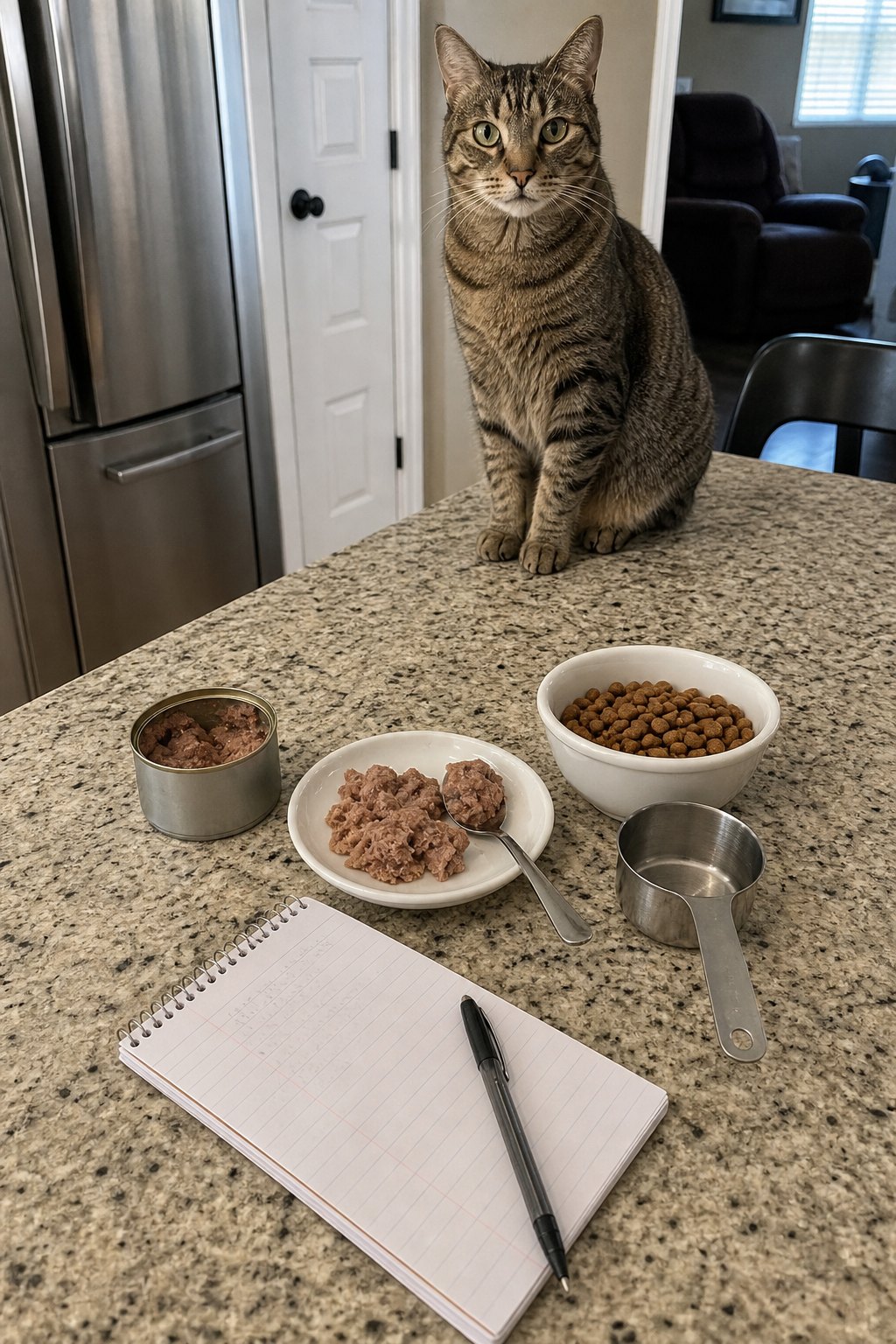
That doesn’t make one format better. For the full wet-versus-dry comparison, see wet vs dry cat food.
4. The ingredient list
Ingredients are listed in order by weight, heaviest first. Cornell’s feeding guide for cats says the same, and AAFCO’s label rules require it.
That order is useful, but keep your conclusions modest. It shows what’s there in the largest amounts, not whether the food is well made. It also can’t tell you if the diet is complete. The adequacy statement does that job.
5. Calories and feeding directions
The calorie statement is given in kilocalories (kcal) per familiar unit, such as per can or per cup, as fed. That makes it the number to use when you portion a meal.
Texas A&M’s veterinary school says most adult cats need about 200 calories a day. Here’s how that works with an invented can that lists 85 kcal per can:
- 200 / 85 = about 2.35 cans
- That’s roughly 2 1/3 cans a day
Real cats vary, so treat that as a rough starting point. Feeding directions on the package are guidelines that may need adjusting for your cat. Your cat’s ideal weight matters here (the cat weight calculator can help), and so does your vet’s advice. If your cat is gaining or losing weight, or needs a special diet, these questions to ask your vet can help you get a plan for your cat.
6. Who made it
Every label has to name the company responsible for the product, with an address. If that company didn’t make the food, you’ll see “manufactured for” or “distributed by.”
Texas A&M suggests contacting the company if you want specifics about a food. This is where to find the contact details.
Words that sound good but don’t tell you much
Marketing words and pictures can be appealing, but none of them tell you the food is complete and balanced. Only the adequacy statement does that.
- Seals and endorsements. FDA says these are not assurances of nutritional adequacy and may be misleading.
- “Proven.” AAFCO says this word can’t be used without evidence behind it.
- “Light,” “lite” and “low-calorie.” These mean the calories are reduced. Check the calorie statement to see by how much.
Example: reading one label from top to bottom
This label is invented, with no real brand, so you can practice. The numbers are mine, made up for illustration.
Chicken Dinner for Cats (canned, 3 oz can) Animal feeding tests using AAFCO procedures substantiate that Chicken Dinner for Cats provides complete and balanced nutrition for adult maintenance. Guaranteed analysis: Crude protein (min) 10%, crude fat (min) 5%, crude fiber (max) 1%, moisture (max) 78%. Calorie content: 85 kcal per can.
Walk through it in five steps:
- Adequacy. It uses the feeding-trial wording and says “adult maintenance.” Good for an adult cat, not for a kitten.
- Name. “Dinner” follows the 25% rule. Chicken is at least 25% of the product not counting added water, and at least 10% of the total.
- Guaranteed analysis. All four guarantees are there. On a dry matter basis, protein is 10 / 22 x 100, or about 45%.
- Calories. At 85 kcal per can, a cat that needs about 200 calories a day would eat roughly 2 1/3 cans.
- Next step. Ask your vet if the amount fits your cat.
Your next step
Tonight, pull out the food your cat eats now. Find the adequacy statement and check that the life stage matches your cat. Then run the dry matter math on the guaranteed analysis.
For more on feeding, browse the Food & Nutrition hub. New to the site? Start here.