
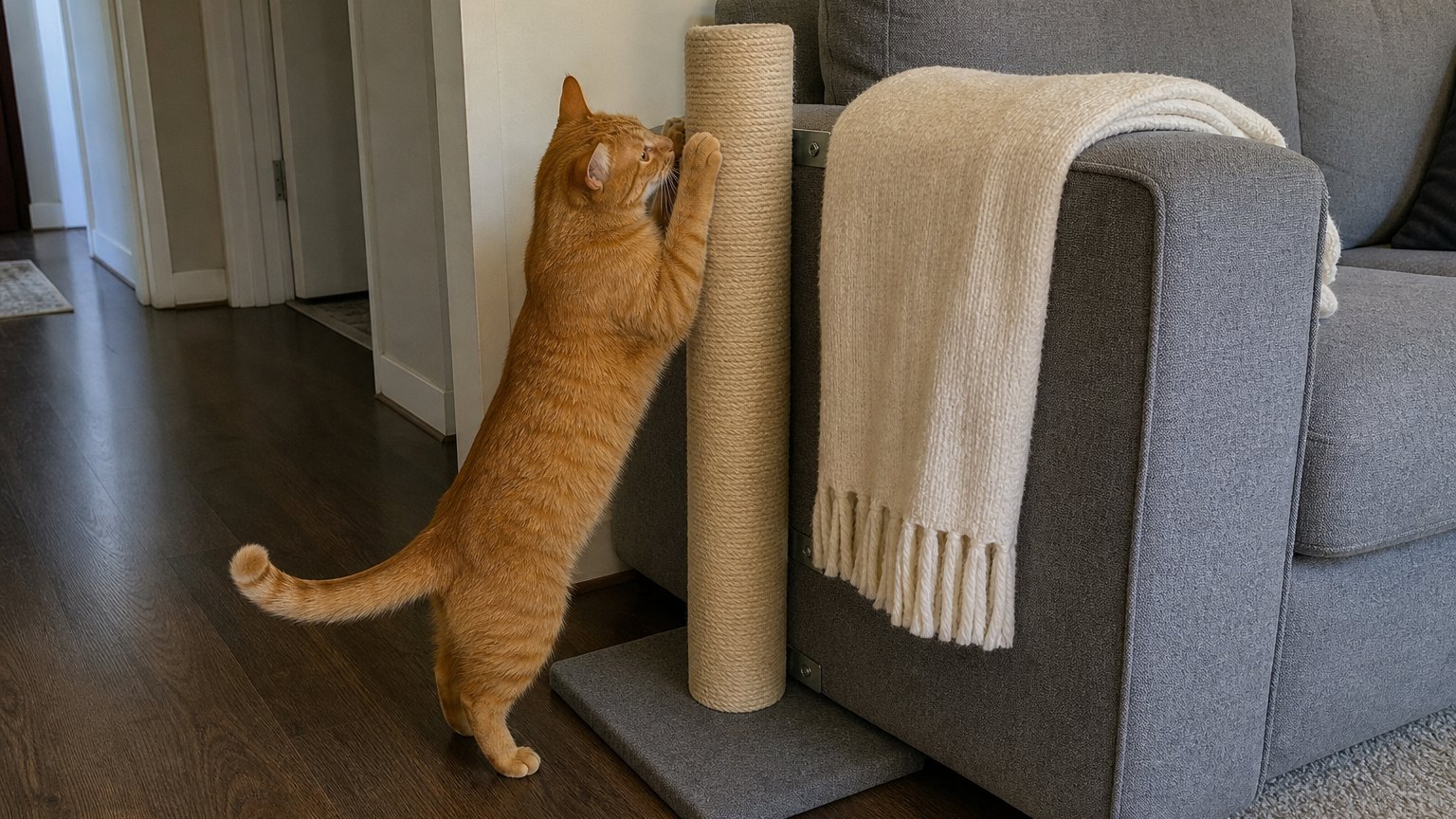
The sofa arm looks like it lost a fight, and the brand-new scratcher across the room hasn’t got a mark on it. You can’t stop a cat from scratching, but you can move where it happens. Put a sturdy scratcher right next to the spot your cat uses on the couch, facing the same direction (an upright post for vertical scratching, a flat pad for horizontal), make that couch spot less appealing for a while, and reward every use.
Move the scratcher only after your cat uses it reliably. Here’s how to read the damage and set it up.
Why does your cat scratch the couch?
Cats scratch because they need to, not because they’re mad at your furniture. The ASPCA says cats scratch to stretch, to mark territory, and to remove the frayed outer layer of their claws. Cornell’s Feline Health Center adds that scratching leaves scent from glands in the paws, and compares it to grooming: it’s innate.
Your couch also happens to be tall, sturdy and in the middle of the home, which is where a cat wants to leave a message. So the goal isn’t “no scratching.” It’s “scratch here, not there.”
How do you read the scratch marks first?
Look at where on the couch the damage is, because that tells you which scratcher to buy or build. Cornell suggests watching whether your cat scratches vertically or horizontally, and the ASPCA notes that some cats prefer horizontal surfaces, others vertical or slanted ones.
Use this table as a starting point:
| Where on the couch | What it suggests | Scratcher to try | Where to put it |
|---|---|---|---|
| Arm, top to bottom | Vertical stretch | Tall, sturdy post | Right against that arm |
| Front base or skirt | Horizontal scratching | Flat cardboard or sisal pad | On the floor in front of it |
| Back of the couch | Tall stretch or marking | Tall post | At the back corner |
| Seat cushions or top | Horizontal or slanted scratching | Slanted or flat board | Nearby, within easy reach |
This is my reading of the two sources, not a rule. If your cat does something different, trust the cat.
Where should you put the scratcher?
Put it right next to the spot your cat already scratches. Both the ASPCA and Cornell recommend placing the post beside the object your cat likes, so it works as a “legal” alternative. A scratcher in the spare room can’t compete with a couch your cat passes all day long.
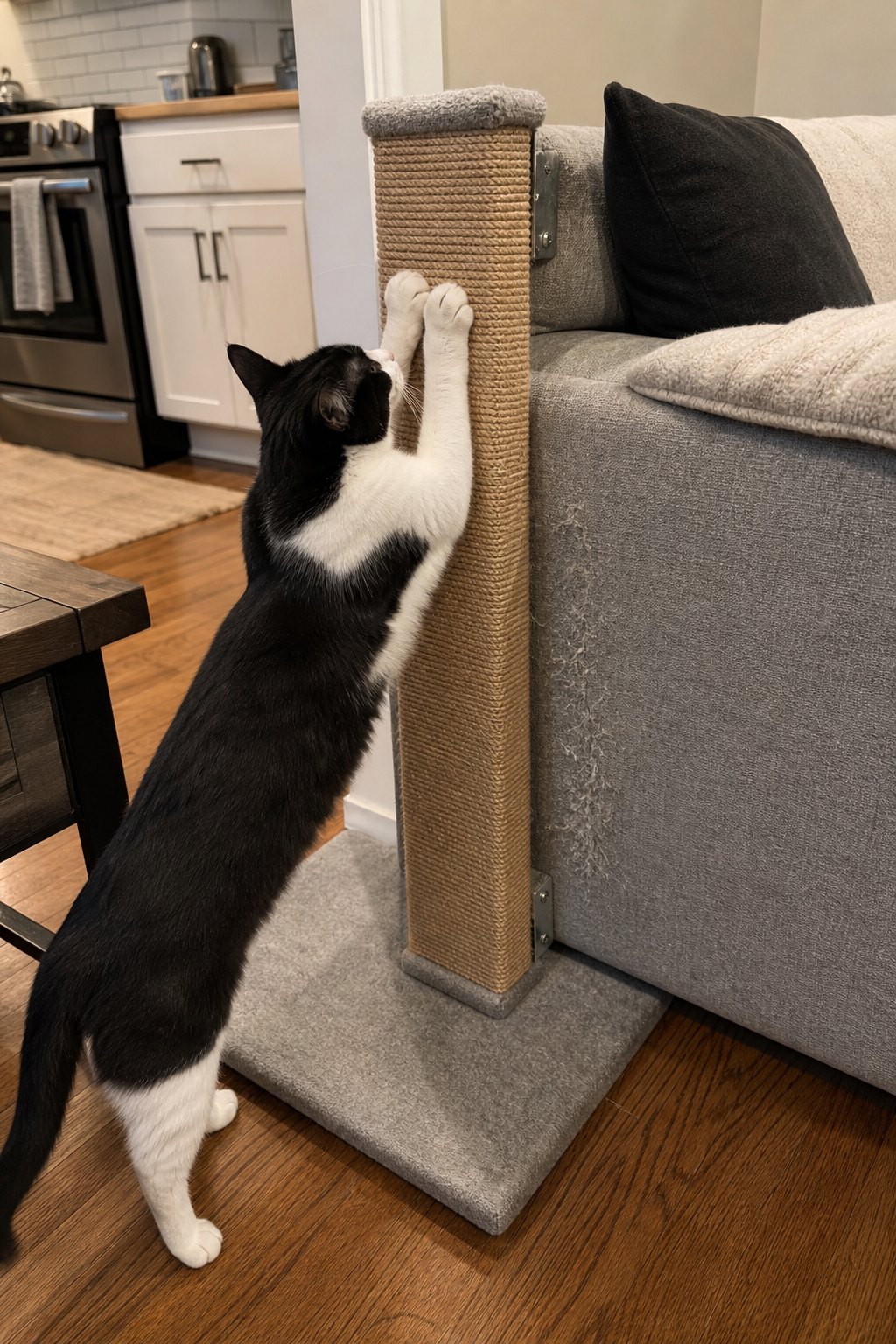
If your cat has several favorite spots, Cornell suggests a post near each one. Think about where your cat stretches after a nap, too. If the couch is the first thing they reach after waking up, that’s the spot to cover.
Once the scratcher has a permanent home, you can make it look like part of the room. Our cat corner ideas for the living room show ways to do that without a pile of carpet in the middle of the floor.
How do you pick the right scratcher?
Match the scratcher to what your cat is already doing: height, direction and texture.
- Tall enough to stretch. Cornell says the post should be at least as tall as your cat standing on its hind legs. The ASPCA’s general care guide suggests at least three feet.
- Sturdy. If it wobbles or tips, your cat will go back to the couch. Both the ASPCA and Cornell say a post shouldn’t shift or topple.
- Matching texture. Cats like cardboard, carpeting, wood, sisal and upholstery, according to the ASPCA. Cornell suggests sisal or a rope-like surface, a flattened cardboard box for horizontal scratchers, and a carpet-covered post for cats that scratch carpet.
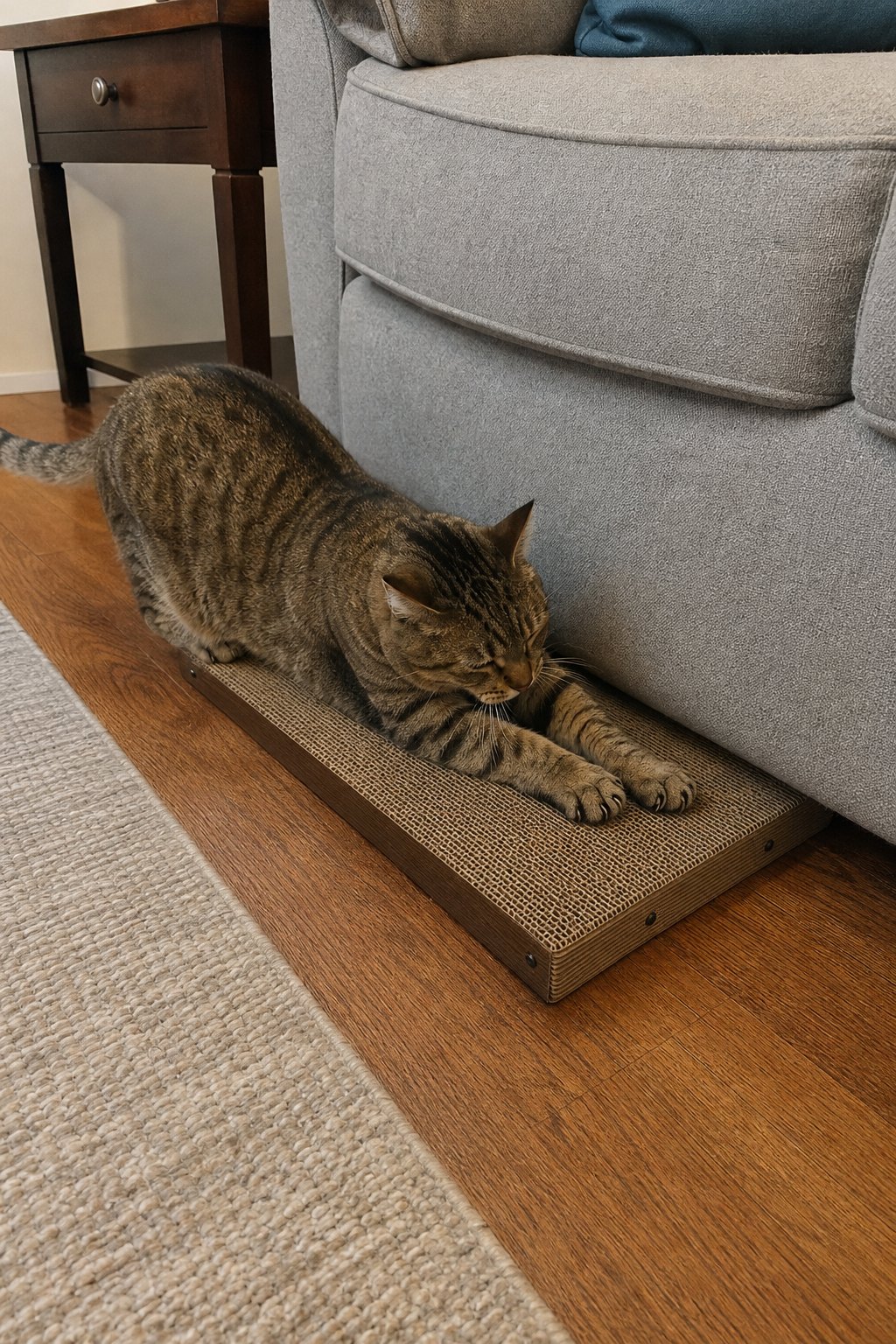
- Right direction. A flat pad suits a cat that scratches the front base of the couch. The ASPCA notes that many cats like scratching pads.
If you want a tall post that won’t wobble, you can build a tall, sturdy sisal post yourself. For other options, see the scratcher ideas in our enrichment guide.
How do you make the couch less appealing for now?
Cover the spot your cat uses. Cornell suggests blankets, sheets of plastic or double-sided tape, and the ASPCA lists plastic, double-sided sticky tape and sandpaper as ways to make an object unattractive.
This is temporary. Once your cat uses the new scratcher out of habit, you can take the cover off. Leave the scratcher where it is while you do.
How do you reward the switch?
Make the new scratcher the fun option. The ASPCA suggests scenting it with catnip and hanging toys from it. Cornell suggests treats, strokes and praise when your cat uses it, and enticing them over with treats or catnip.
Skip the punishment. Cornell says cats don’t respond well to it and that yelling or squirting a water gun only teaches fear.
When can you move the scratcher?
Wait until your cat uses it every day for a couple of weeks, then shift it a little at a time, a foot or so every few days, and watch whether your cat follows. Those numbers are my rule of thumb, not from the sources.
If your cat stops using it, move it back. You can also leave it where it is. It’s furniture now.
The ASPCA says not to throw away a favorite post, even if it looks ragged. If you add a new one, keep the old one nearby.
Should you trim nails, and what about declawing?
Trim nails regularly. The ASPCA says trimming every two to three weeks keeps them relatively blunt, which means less damage if your cat slips back to the couch. If you’re nervous about it, our questions to ask your vet can help you ask for a demo at your next visit.
Plastic nail caps are another option. The ASPCA says they’re temporary and last four to six weeks. Cornell says they’re glued on, only suit cats that allow handling, and need replacing every 6 to 12 weeks.
Skip declawing. Cornell describes it as amputation of the bones at the tips of the paws and calls it an absolute last resort. The ASPCA is strongly opposed to it and says it isn’t proven to improve behavior.
What should you do tonight?
Look at your couch and find the worst spot. Check whether the marks run up and down or side to side, then put the matching scratcher right against it. Cover the couch spot, add a little catnip, and give your cat a treat for the first scratch.
Got a kitten? Starting early helps, and our kitten-proofing guide covers the rest of the house. For more of this kind of thing, the Behavior hub has the rest of our cat-behavior guides.